










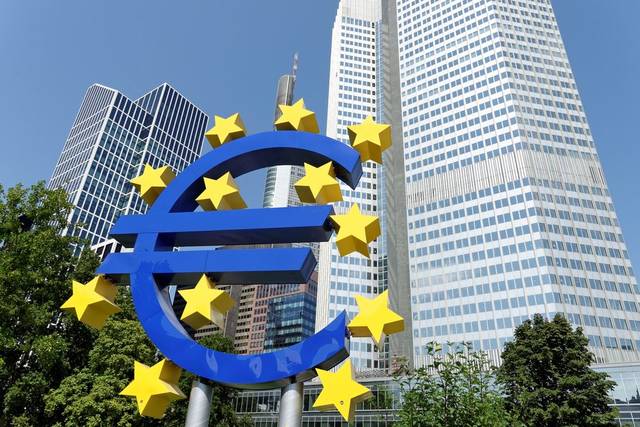
Mubasher: Mario Draghi, the president of the European Central Bank (ECB), on Tuesday confirmed that the ECB would likely phase out its quantitative easing (QE) policy after its next meeting on 13 December.
During his speech at the European Parliament in Brussels, Draghi also defended the bank's move to gradually terminate its EUR 2.6 trillion bond-buying programme against criticism from European lawmakers that it is moving too soon as eurozone economic growth slows down, MarketWatch reported.
The programme is widely credited with boosting economic growth in eurozone, outperforming the US economy over the past two years.
However, the ECB is phasing out its stimulus programme amidst the slowest growth rate recorded in the 19-nation bloc in about four years, as well as borrowing costs jump in Italy, the bloc's number-three economy, leading to a clash with the European Union (EU) over its budget.
Mr. Draghi agreed that recent economic data had been weaker than expected, but argued that this reflected temporary headwinds, as well as a natural slowdown from very brisk growth rates.
European lawmakers questioned the ECB's decisions. Marisa Matias, from Portugal, asked whether the recent slowdown in the eurozone may or may not be linked to the decision to phase out QE.
The slowdown wasn't serious and came after a period of very strong growth and job creation, Draghi emphasised, assuring that even after ending the bond purchases, the ECB's policies will remain very loose.
Two other top ECB officials struck a similar note on Monday, underscoring the ECB's resolve.
Peter Praet, the ECB's Belgian chief economist, on Monday blamed the eurozone slowdown in part on one-off factors, though he conceded that the bloc was being buffeted by a rise in trade protectionism, financial-market volatility and weaknesses in emerging markets.
Sabine Lautenschlaeger, a German member of the ECB's executive board, also said she is confident that the ECB would start raising short-term interest rates, currently set at minus 0.4%, next year.
At the Parliament, Ludek Niedermeyer, a Czech lawmaker, questioned whether the ECB would be able to support the economy in case of a serious slowdown. Draghi answered that such a scenario is unlikely, and the economy is still strong by historic standards.
On the other hand, officials in Germany and the Netherlands have complained for years about the ECB's ultralow interest rates, which they worry hurt savers, pensioners and banks.



