










Mubasher: The Organisation for Economic Cooperation and Development (OECD) lowered its forecasts for global growth for 2019 and 2020, expecting the expansion rate for this year to hit its lowest level since a decade.
In its Interim Economic Outlook, the OECD highlighted the mounting frailty and uncertainty of the global economy.
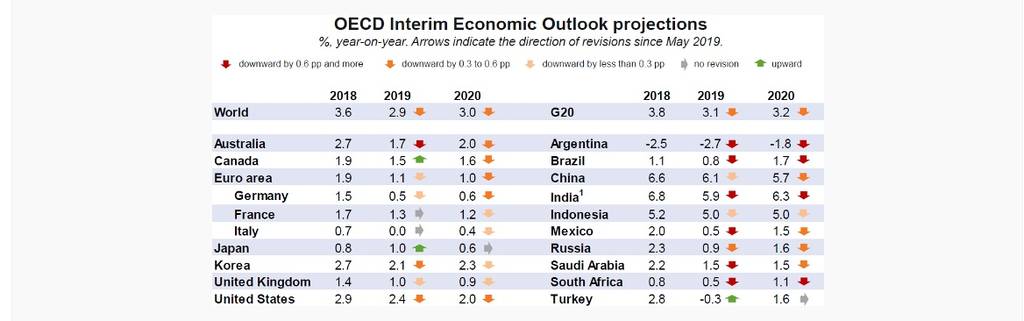
The world’s economy is now expected to slow down to 2.9% from a growth rate 3.6% last year, the OECD said.
This came below last May’s forecast of 3.2%, while it marked the most sluggish figure since the 2008-2009 financial crisis.
The Paris-headquartered organisation expected this year’s growth rate followed by a rate of 3% next year, extending a downward turn in its outlook since last May, when it predicted the global economy to expand at 3.4%.
“Escalating trade conflicts are taking an increasing toll on confidence and investment, adding to policy uncertainty, aggravating risks in financial markets and endangering already weak growth prospects worldwide,” the organisation said.
The OECD lowered its growth forecasts for the US, expecting the world’s largest economy to grow at 2.4% and 2%.
For China, the world’s second biggest economy is predicted to grow at 6.1% this year, while the expansion rate for next year will hit 5.7%.
“Risks of a sharper slowdown and a prolonged period of very weak import demand are intensifying,” the organisation said.
“What looked like temporary trade tensions are turning into a long-lasting new state of trade relationships,” OECD chief economist Laurence Boone told Reuters.
Post-Brexit growth
Amid growing uncertainty over the timing and nature of the UK’s exit from the European Union (EU), the OECD expected the UK economy to grow at 1% this year and 0.9% next year in the event of a smooth departure with a transition agreement, down from last May’s forecasts of 1.2% and 1%.
At the other end of the spectrum, a no-deal Brexit could be 2% lower than otherwise in2020-2021.
“A no-deal exit would be costly in the near-term, potentially pushing the United Kingdom into recession in 2020 and reducing growth in Europe considerably,” the OECD said.



